Cis People and Their Gender-Affirming Rituals
There is something queer about beinc cis.
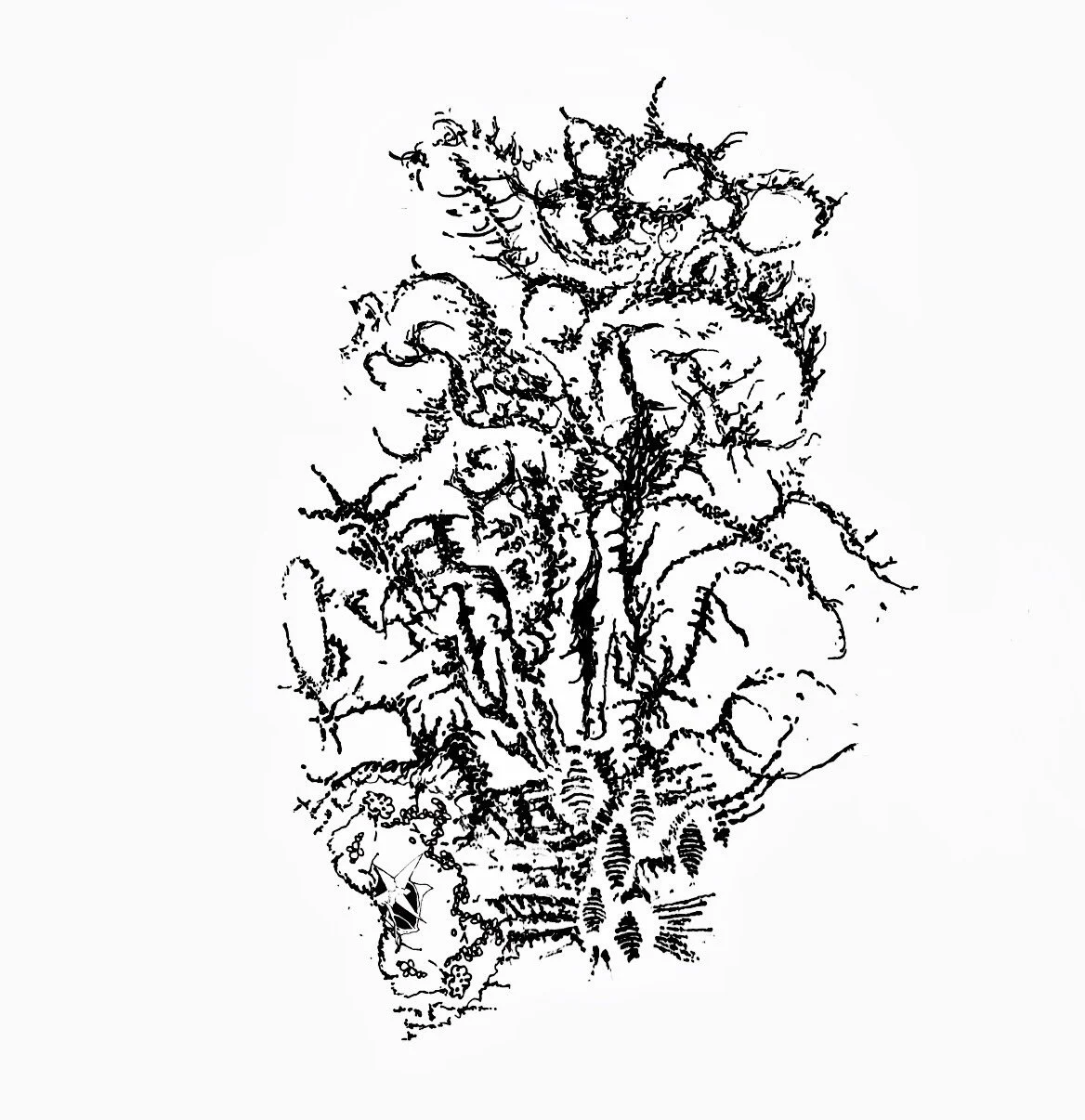
Illustration by Sophia Ghoneim, 2025
Actionable Identities and Hierarchy
Some straight, cisgender people do not want queer theory to be applied to them, but that doesn't mean that it shouldn't. Feelings of gender misalignment are most often analyzed in relation to transgender people, though they are also rampant in cis people, where they are excused as personal insecurities or dulled by affirming rituals. In reality, gender does not come naturally to anyone, and the organic alignment that we pretend cisgender people have with their assigned sex is not nearly as painless and effortless as it seems.
Some common bodily rituals performed by cigender women include practicing skincare regimens, nail maintenance, and hair practices (shaving, shaping, styling). A few that demonstrate the emphasis on morphing are the use of makeup (for concealment and definition), and silhouette shaping (bras, shapewear). More radical changes include hormonal contraception for skin and weight control, and cosmetic surgery (lip filler, Botox, BBLs, breast augmentation, liposuction). These rituals and practices aim towards the embodiment of the female gender ideal. The performance of gender for men only seems less actionable as it is performed in an attempt to appear more ‘natural.’ It is a type of grooming that aims not to be identified as grooming; for example, a “For Men” shaving cream avoids the idea of a man grooming themselves the same way a woman does. Male gender performance relies more on mimicking the unintentional ruggedness of nature than constructing artificial perfection; controlled but never decorative.
In men, however, we still see radical changes such as jaw enhancement surgeries, chin implants, and most interestingly, anabolic steroids or testosterone use. The latter brings up the interesting practice of self-modification through exercise; women and men tend to work out in different ways and with radically different goals in mind, or they’re expected to. One works towards weight loss, being “toned,” growing glutes, while the other focuses on bulking and body building. If eating rice and chicken every day, going to the gym for 2 hours, 4 times a week, and drinking protein powders/creatine to artificially enhance your diet, motivation, and muscle growth isn’t an attempt to change yourself from the inside out to embody the male gender, then what is it?
We can also see here how performance is a matter of hierarchy. Women are expected to perform more radically because to be a woman is to become a woman through actions of maintenance. This is partly because women are seen as a mythical subspecies, an addition to the original, natural Man, which, in its rugedness, seems to require little modification. Men are the the unadulterated drivers, carrying the mental load of humanity, and women are the vehicles, used to arrive to some purpose. This really answers the question of why unattractive women are so hated by men, and if we’re being honest, by women too. To be an unattractive woman is to be an incomplete woman and an incomplete person, a thing not brought to its full potential or purpose.
This inexhaustive list of mundane and radical changes draws a detailed image of cisgender people not just actively performing gender but partaking in gender-affirming practices. It is important to use the language of queer theory, because this is queer behavior. This is a matter of maintaining and presenting, internally and externally, the illusion of an intelligible gendered self and an attempt at embodying gender purity.
It’s more important now than ever to take a step back and view things very bluntly, because ancient understandings of gender, gender identity, and gender performance are being rebirthed through more insidious language (“in my feminine/masculine energy,” “high-value women don’t chase, they attract,” “divine essence,”). Within this discourse, essentialism is meant to be comforting and rewarding. What we know to be a limiting and precarious position, primarily for women, is being reframed as “divine.” This language suggests that women can attain freedom by only concerning themselves with the project of the gendered self. One of the ways to combat this discourse is demonstrating the robotic nature of these performances, highlighting in fact, how unessential it is to be gendered, and further, how much of an endless chore it is.
There is hope in failure
Perhaps we don’t recognize cis people’s practices as gender-affirming because they are the very way in which gender is created. The very rituals of gender-affirmation are the same ones that create gender:
The relationship between following a line and the conditions for the emergence of lines is often ambiguous. [...] A path is made by repeatedly passing over ground. [...] A paradox of the footprint emerges. Lines are both created by being followed and are followed by being created. The lines that direct us, as lines of thought as well as lines of motion, are in this way performative: they depend on the repetition of norms and conventions, of routes and paths taken, but they are also created as an effect of this repetition. To say that lines are performative is to say that we find our way, we know which direction we face, only as an effect of work, which is often hidden from view. So in following the directions, I arrive, as if by magic. (Ahmed, Orientations, 2006).
In this repetition (repetition which is work), labor is made effortless, expected, and invisible:
We might note here that the labor of such repetition disappears through labor: if we work hard at something, then it seems “effortless.” This paradox—with effort it becomes effortless—is precisely what makes history disappear in the moment of its enactment. The repetition of work is what makes the signs of work disappear. (Ahmed, Orientations, 2006).
But it is so, so important to acknowledge that cis people do this work too, as it points out that anyone can do this work. Being a woman is merely pretending to be a woman, whether or not it was assigned to you at birth. When it comes to the point where a cisgender individual feels that gap, when they still feel like their assigned gender, but just not good enough of a man, or good enough of a woman, what do we call that? Why don’t we recognize this as a sort of gender crisis rooted in the impossibility of embodying gender ideals? I believe it is because we are all aware that failure is expected, especially as a woman.
A normalized product and process of embodying gender ideals is its failure, a woman is not an embodiment of a gender ideal, rather her entire life is expected to be a pursuit of that embodiment, and its failure is a part of the process. It’s normal to obsess over your weight, it’s normal to feel like a monster between waxing appointments, and to hate your wrinkles later on. In fact, not worrying about being the gender ideal is highly frowned upon. On the other hand, a woman who seemingly does embody the gender ideal is also frowned upon. To be a woman is the constant and expected failure of being a whole woman. Thus, gender-based identity crises are not seen as gender-based insecurities or even as abnormal, or something that should be worked through, they are a “natural” occurrence, and a part of the work.
The question stands: why are cisgender people so hesitant to examine their practices of gender embodiment and most incessant insecurities as products of something much bigger than their own making? A professor of mine compared it to someone whose parents hit them as a child. They might recognize that what their parents did was wrong, but if you were to tell them that their parents were bad people, they wouldn’t take that too well. They might even start defending their parents, saying that they deserved it; in fact, that you need to hit children to avoid them becoming too spoiled. If gender ideals are completely made up, all these insecurities, the need to measure up, the feelings of inadequacy, would become completely meaningless. It would’ve all been for nothing. But as Ahmed notes, “there is hope in such failure.”
Phenomenology, after all, is full of queer moments, moments of disorientation, which involve not only “the intellectual experience of disorder, but the vital experience of giddiness and nausea, which is the awareness of our own contingency and the horror with which it fills us.” (Ahmed, Orientations, 2006).
Sophia Ghoneim (Blurbs’n Blobs)
Personal, scrappy, and diary-like, Blurbs’n Blobs is a feminist magazine dedicated mediating the gap between writers and readers, as to well as creating intimacy between strangers. Tinnitus reads it and loves it!
You check it out browsing blurbsnblobs.wordpress.com or searching for @blurbs_n_blobs on Instagram.
sources:
[1] Jill J. Avery, Gender Contamination
[2] The cultural associations of mind with masculinity and body with femininity are well documented within the field of philosophy and feminism,” Judith Butler, Gender Trouble
[3], [4], [5] Sara Ahmed, Orientations: Towards a Queer Phenomenology
